King Philippe’s first state visit to Kazakhstan gave a quiet raw-materials courtship the weight of high politics. Executives say the harder test is only now beginning.
ASTANA — Fighter jets escorted the royal aircraft through Kazakh airspace. An honour guard and the presidential orchestra stood on the tarmac, and President Kassym-Jomart Tokayev was there to greet his guests in person. When King Philippe and Queen Mathilde of Belgium touched down on 11 October, they began the first state visit to Kazakhstan by a Belgian monarch — a four-day programme that both capitals cast as a milestone ahead of the 35th anniversary of diplomatic relations in 2027.
The ceremony was matched by symbolism. At a joint briefing Tokayev set Belgium’s motto, “L’union fait la force”, beside a Kazakh proverb that where there is unity, there is life. King Philippe, who cited the poet Abay, closed in Kazakh with the traditional wish that his hosts’ shanyrak, the crown of the yurt, stand high.
Behind the pageantry lies real money. Tokayev said Belgian investment in Kazakhstan has exceeded €13,4 bn since 2005. Belgium ranks among the country’s ten largest foreign investors, with more than 100 Belgian and joint companies operating there, and bilateral trade rose by almost 10% in the first eight months of 2026, Kazakh media reported. Tokayev called the ranking “convincing evidence” of confidence in Kazakhstan’s economic future. The joint statement the two leaders signed runs to 19 points, from petrochemicals and transport to artificial intelligence and health, but it singles out critical minerals: it stresses the strategic importance of cooperation and welcomes a round table on the subject held during the state visit.
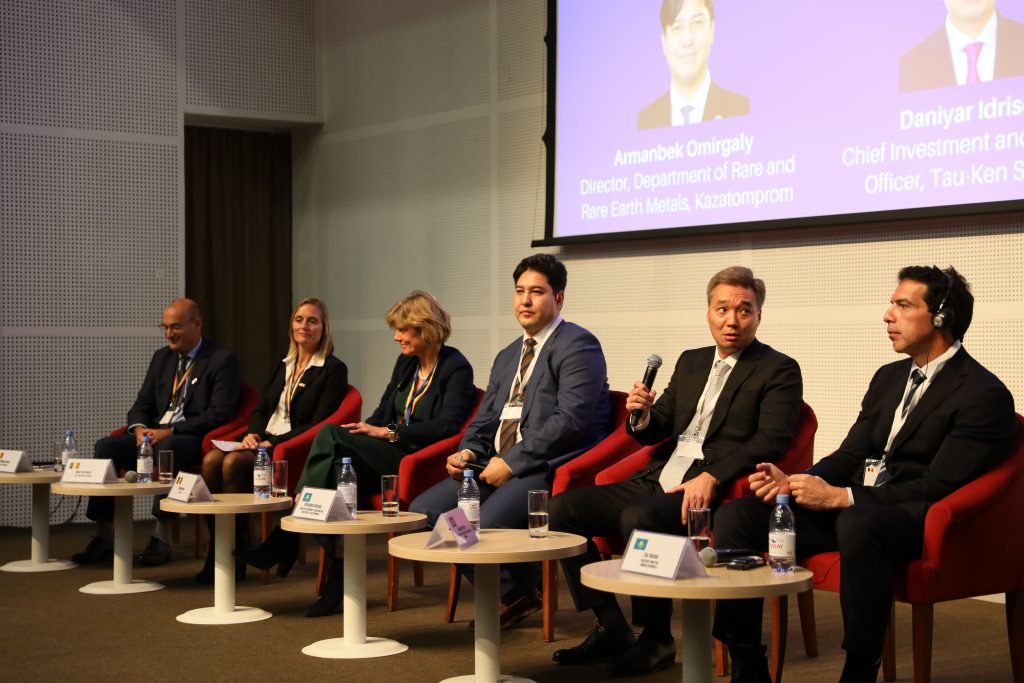
The substance was tested on 12 October at Nazarbayev University, where the Belgium-Kazakhstan Critical Minerals Seminar — organised by SIM² KU Leuven and Nazarbayev University, and backed by Kazakhstan’s ministries of Industry and Construction and of Science and Higher Education — drew industry leaders, researchers and officials under a blunt motto: “From MoUs to shovels in the ground”. The first session examined how to build competitive critical raw materials value chains, with Belgian companies and research organisations joined on the industrial panel by Kazatomprom, Tau-Ken Samruk and Lindian Kazakhstan; the second turned to research cooperation between Belgian and Kazakh universities and ministries. Both sets of conclusions went to a Royal Critical Minerals Round Table attended by Their Majesties.
Kazakhstan’s pitch: more than a quarry
Astana’s message is that it wants to be more than a quarry. Kazakhstan has the potential to supply 21 of the 34 critical raw materials identified by the European Union, Vice-Minister of Industry and Construction Olzhas Saparbekov told the seminar. The figure indicates the breadth of its potential contribution; it does not mean that commercially viable supplies are already available for all 21 materials.
The groundwork is still early. According to the ministry, more than KZT 67 bn (approximately €134 million) has been allocated to geological studies since 2018, covering over 2mn square kilometres, with coverage expected to reach 2.2mn by the end of 2026. Exploration across 11 raw material search areas has identified 38 promising sites. These figures describe an expanding exploration pipeline, rather than proven reserves or projects ready for construction.
Kazakhstan already produces tantalum, niobium and beryllium and recovers molybdenum and rhenium, and a gallium production facility with planned capacity of 15 tonnes a year is envisaged. Priority products include battery materials, special alloys, semiconductor materials and permanent magnets: materials that must meet the specifications of high-technology customers.
“Given its current potential and capabilities, Kazakhstan could occupy a unique position globally as a participant in critical raw materials midstream industries, playing a key role in ensuring stable and resilient global supplies,” Saparbekov said. Midstream — the processing, separation and refining that connect the mine to the factory — is where Astana wants to stand.
Molymet: a template that already works
The clearest evidence that the model can work comes from Molymet. Nele Van Roey, the company’s chief executive, gave a keynote speech and joined the industrial panel. Molymet has no active investments in Kazakhstan yet, she said, but Molymet Belgium runs two contracts with Kazakh partners: processing molybdenum concentrates from Kazakhstan, and selling by-products back. “It’s a two-way collaboration,” she said, with raw materials travelling to Belgium and processed materials returning to Kazakhstan.
Her verdict was positive. The contracts are executed as agreed and in a professional way, making Kazakhstan a really good business partner on critical raw materials. To move from raw exports to higher-value products, she pointed to tolling, under which the mine remains owner of the material while Molymet upgrades it for further processing or sale to the steel industry. By-products, sludges, concentrates and metal recovery offer other routes; opportunities, she stressed, exist across the whole value chain, from mining to recovery.
The obstacles, though, are practical. Van Roey named two. The first is language: Belgian partners do not speak Russian, and translation is not the same as communicating in one’s own language. The second is logistics. Transport of molybdenum once took about three weeks; with the Russian border closed, cargo now goes via the Caspian Sea and Turkey, which is slower and raises questions of financing and price risk in a volatile market. That is where politics comes in. Tokayev has asked for a practical partnership between the Antwerp-Bruges port complex and Kazakhstan’s Caspian ports of Aktau and Kuryk, part of the Middle Corridor linking Asia and Europe.
Van Roey described the Belgian approach as bottom-up, built on commercial relationships between companies. Europe, she argued, should not manage execution but create the legal and strategic framework and the political will for countries to cooperate. Both sides should also share more information about their strengths, so that opportunities are detected faster. Kazakhstan, she noted, is among the closest molybdenum sources to Belgium, while alternatives in the U.S. and Latin America lie much further away.
Molymet is now studying investment in Kazakhstan, but it needs a solid business case, since the funding must be private rather than coming from Belgium or the European Commission. “If the volumes of molybdenum concentrates are assured,” Molymet Group could build processing facilities locally. A memorandum of understanding has already been signed.
Astana’s answer, Saparbekov said, is a phased approach in which processing would gradually move to Kazakhstan together with technology and expertise. Talks covered raw-material processing, metal separation and refining, engineering and equipment, as well as logistics and financing. Antwerp was discussed as a route for finished products to Europe, alongside a possible combination of European financing instruments and Kazakh state support. The commercial test will be whether these arrangements can support competitive local production and reliable deliveries.
KU Leuven: a different kind of partnership
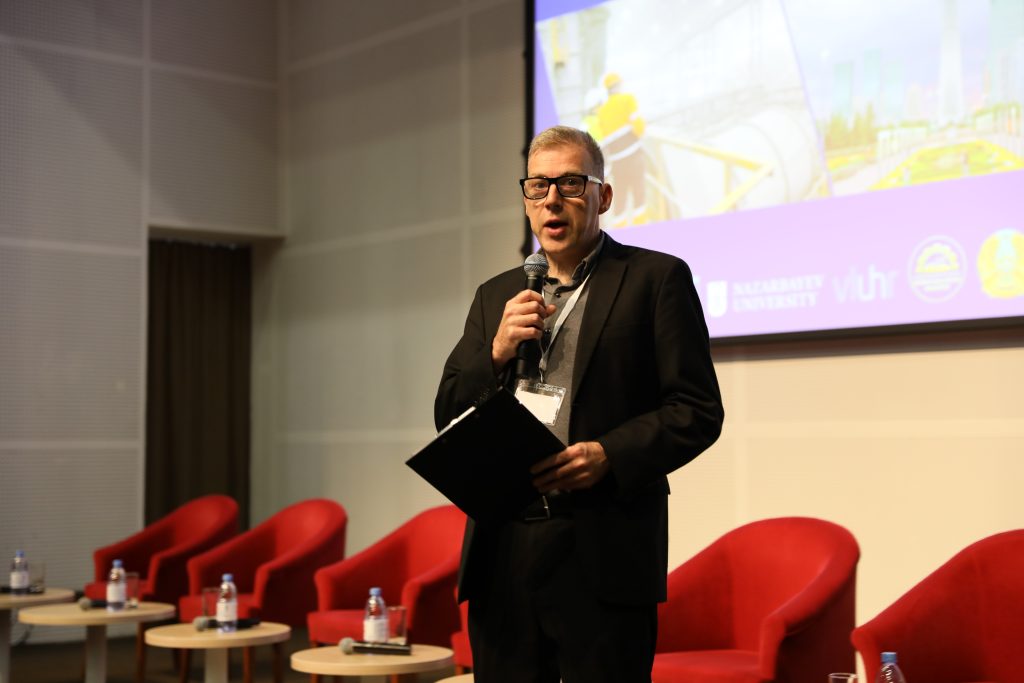
Peter Tom Jones, director of SIM2, Sustainable Metals and Minerals institute of KU Leuven university, who opened the seminar and moderated both panels and the fireside chat with Minister of Science and Higher Education Sayasat Nurbek, said his view changed during the day. He first saw Belgium’s best fit in midstream refining, but now sees cooperation across the entire chain: exploration, mine development, processing, refining, building materials from residues, and energy, water and life-cycle management.
Kazakhstan, he argued, should capture more of the value at home. Models based mainly on extracting materials for refining elsewhere leave the added value of pure metals abroad. Kazakhstan already excels in base metals such as copper, zinc and lead, but there is much to win in accessory metals that come as co-products from major mines, and in converting concentrates into finely refined metals. Belgium and Europe, he said, can offer a different model: technology, capacity building, long-term training and the tangible and intangible know-how needed to produce metals on a commercial scale.
He was candid about the limits. Europe cannot offer large funding, as research, education and industrial budgets are being cut. The EU’s roughly €10bn for critical raw materials sounds large, but one new mine can cost a billion. Public money must therefore trigger private investment, which requires trust. What Belgium can offer, he said, is technology transfer, expertise and passion for metals.
On the environment, he highlighted zero-waste metallurgy: recovering indium and germanium from zinc streams, and turning slags into low-carbon cements, geopolymers and concrete. With Kazakhstan’s construction boom and the heavy CO2 footprint of Portland cement, this could cut emissions, provided tailings are located close to urban centres and transport costs stay reasonable.
Concretely, KU Leuven is setting up a joint research centre with East Kazakhstan Technical University (EKTU) on mineral processing, hydrometallurgy, pyrometallurgy and building materials, aiming at contract research with Kazatomprom and a metallurgical plant, with Kazakh students learning on real cases. It builds on momentum from the Kazakh-Belgian rectors’ forum on 13 October, attended by Tokayev and the royal couple, where universities from both countries signed a series of agreements and memoranda. Funding for equipment and operations remains an open question, and Jones expects it to come from both government and companies. His advice to the Ministry of Education: create industrial research managers, as in Belgium, to connect professors with companies. Forty such managers, he said, can make more difference than an average professor.
Separately, the ministry has reported a Regional Research Centre for Rare Earth Metals involving EU institutions. The EBRD has supported preparation of a preliminary feasibility study. With European Commission support, construction of a complex of geochemical, umpire-assay and scientific metallurgical laboratories is planned to begin in 2027, with commissioning in 2028. These dates remain planned milestones, and the ministry’s account does not establish that this is the same initiative as the KU Leuven–EKTU centre described by Jones.
Hydrometal: critical metals from industrial leftovers
Philippe Henry, chief executive of JGI-Hydrometal, offered a concrete example of circular metallurgy. The group runs four industrial plants worldwide. Hydrometal in Belgium produces zinc sulphate and zinc salts while valorising by-products of the non-ferrous industry in Belgium, Germany and France. In Thailand the group recovers lead, tin and antimony and is a world leader in low-alpha tin for electronics. In Dunkirk it produces zinc oxide for the tyre industry from copper-industry residues, using a distinctive hydrochloric acid chemistry, and in Germany, with a Mexican partner, it recycles electric arc furnace dust.
Zinc is the core product but also a carrier of copper, lead, tin and minor metals such as indium and germanium, which the company recovers as critical metals. A Kazakh delegation visited Hydrometal three weeks before the seminar and appreciated this recovery.
Henry sees by-products as the key opportunity: some 36,000 tonnes a year in Kazakhstan, small next to 300,000 tonnes of primary material, but rich in resources. The challenge today is to stimulate a joint decision on prioritising them. He agreed that logistics is the main practical obstacle, and said the Belgian side wants to play a role in unlocking this potential.
Belgium’s lasting asset, he said, is expertise, from its non-ferrous industry to its universities and technology centres, which can help extract the last units of value. It may take two years instead of one, as in China or the U.S., but the result will be robust and long-term.
Why Brussels is listening
For Europe, the strategic context extends beyond individual contracts. The EU Critical Raw Materials Act sets 2030 benchmarks for domestic capacity equivalent to 10% of annual consumption of strategic raw materials in extraction, 40% in processing and 25% in recycling. It also seeks to limit dependence on any single third country to 65% for each strategic raw material at any relevant processing stage. These objectives give Brussels an incentive to diversify supply chains. For Kazakhstan, the negotiating question is how much processing, technical expertise and industrial value will remain in the country.
The next measure of progress will therefore be project maturity. Tokayev has said he will personally oversee the implementation of promising projects, and the ministry expects a list of joint projects with identified partners and initial technical steps, from exchanging samples and conducting tests to preparing feasibility studies. Announced capacity, promising exploration sites and memoranda should be assessed separately from financed plants, confirmed production and long-term purchase contracts.
The bottom line
For Kazakhstan, the royal state visit has delivered what money alone cannot buy: the attention of Brussels, home to the EU’s institutions and NATO’s headquarters, and a joint statement that puts critical minerals on the bilateral agenda. What it has not yet delivered is a plant. Molymet’s existing contracts, Hydrometal’s experience in recovering metals from by-products and the planned KU Leuven–EKTU research centre provide a foundation, but turning it into long-lasting value will require viable projects, private investment and the development of local skills. The seminar’s motto set the bar; the shovels will show whether it was met.